For decades, the question has been on the table: ‘Does the age at which you start learning a second language really matter?’ Today, language science, neuroscience and longitudinal studies provide a clear answer: yes, and the data confirms it.
The likelihood of achieving fluency
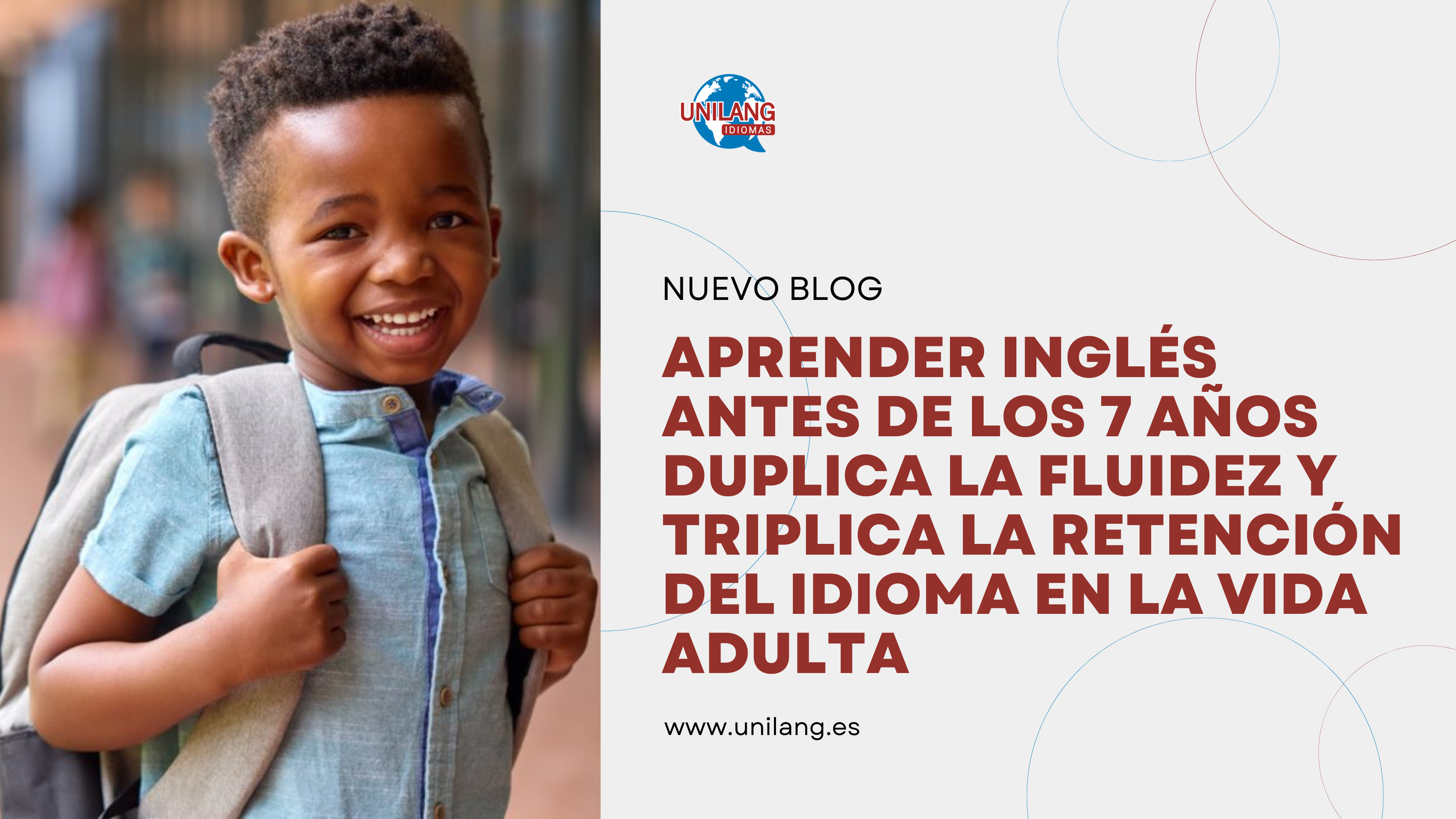
It is not just a question of starting early, but of how much that start influences long-term success. According to studies published in the Applied Linguistics Research Journal, there is a clear gap depending on the age of onset:
0 to 7 years: 70%–80% likelihood of achieving functional fluency.
8 to 12 years: The probability drops to 35%–40%.
13 years and older: It falls dramatically to 15%–20%.
Furthermore, the World Economic Forum highlights ‘retention’: children who start before the age of 7 are three times more likely to retain the language into adulthood.
Areas of greatest advantage: Phonetics and Grammar
Children’s brain plasticity offers benefits that are difficult to replicate at later stages:
Phonetics: The ability to distinguish sounds that do not exist in the mother tongue and to reproduce accents with native-like precision.
Vocabulary and Grammar: Research from the journal IJRISS indicates that an early start results in a broader vocabulary, greater grammatical accuracy and more natural sentence construction (internalisation rather than memorisation).
Academic Performance: A study by the University of Cambridge links early proficiency in English with better results in areas such as mathematics and reading comprehension in primary school.
Unilang’s Great Little People Method
Based on this scientific evidence, Unilang Idiomas has developed the Great Little People method, designed specifically for children aged 3 to 6 in Santander.
Programme features:
Small groups: Maximum of 6 pupils for individualised attention.
Holistic approach: Development of the four skills (speaking, listening, reading and writing).
Learning through ‘Corners’:
Start Corner: Basic concepts and emotions.
Phonics Corner: Sounds and practical phonics.
Active Corner: Movement, dance and experiments.
Reading Corner: Storytelling and over 50 stories.
Let’s Eat Corner: Vocabulary related to habits and food.
Practical details:
Duration: 9 months (October to June).
Timetable: One hour per week in the afternoon.
Location: C/ Rualasal nº 5 – 4th floor, left, Santander.
Contact details:
Telephone: 942 224 294
Email: idiomas@unilang.es
Website: unilang.es
Site web : unilang.es